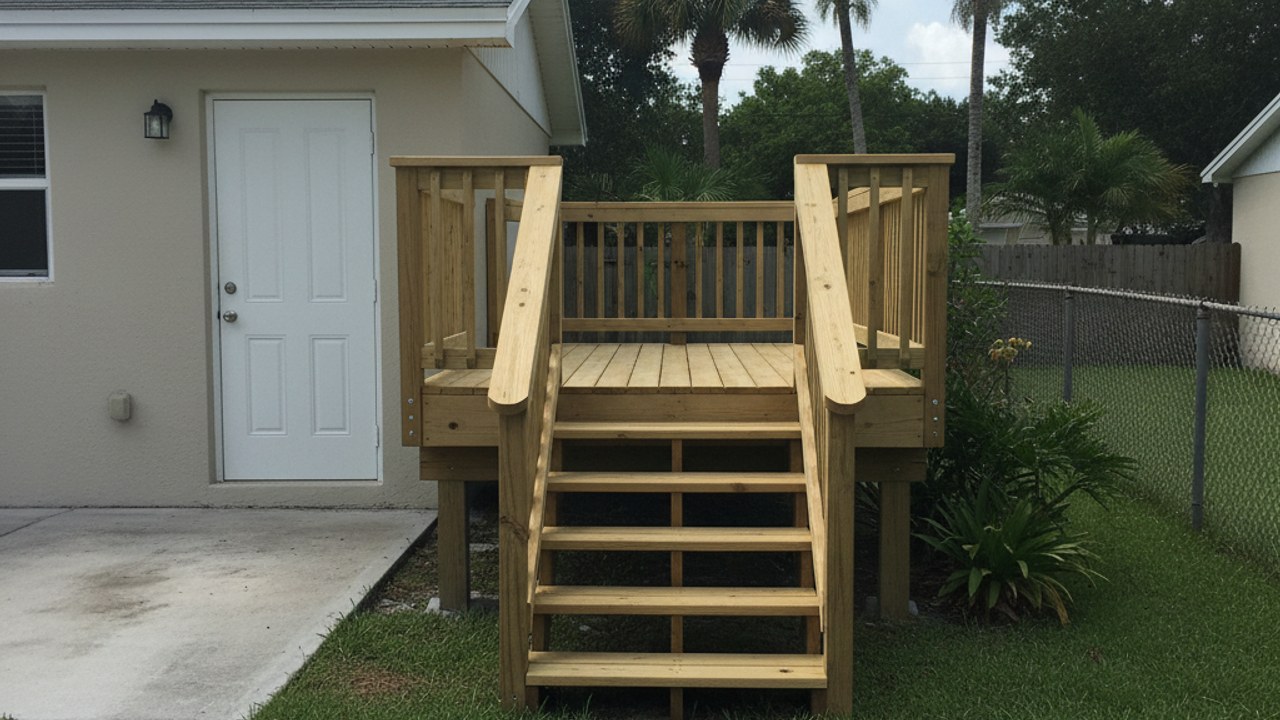
Most homeowners picture dirt as dirt. In Lakeland, what's six inches to four feet down changes from one side of a yard to the other, and it decides how deep we dig, what kind of footing goes in, and whether a deck stays level in five years or starts rocking at the stair stringer.
Polk County sits on the Lakeland Ridge, a strip of higher, sandier ground running through central Florida with limestone bedrock underneath it. That limestone is why this county has more sinkhole activity than most of the state. It's also why the sandy soil on top drains the way it does. Neither of those facts is scary on its own, but both of them matter once you're putting posts in the ground.
Sand that drains fast, until it doesn't
Most lots here are sandy loam. Dig a post hole in July and it'll hold its shape fine until a thunderstorm fills it with water that disappears in twenty minutes. That's good news most of the year. The bad news shows up near low spots, drainage swales, or anywhere close to one of Lakeland's lakes, where the water table sits a lot closer to the surface. Lake Hollingsworth, Lake Parker, Lake Morton, Scott Lake, all the neighborhoods that ring them tend to have soil that stays damp a foot or two down even in the dry season. A footing poured in soil that shifts between saturated and bone-dry is a footing that can heave or settle unevenly. We dig test holes before we commit to footing depth, not just measure off a plan.
Florida doesn't have a frost line the way the Midwest does, so we're not digging four feet down to get below freeze. Code minimum for a deck footing here usually runs around 12 inches, but we go deeper on anything load-bearing, especially a pool deck or a second-story addition, because the sand itself needs more bearing surface than clay would, not less depth from frost.
The lakes change the water table more than people think
A lot that looks dry on a sunny October afternoon can have standing water eighteen inches down by August, after a summer of afternoon storms rolling through June through September. We see this constantly on lots backing up to retention ponds or anywhere within a few blocks of open water. It doesn't rule out a deck. It does mean we're setting posts in concrete sonotubes rather than just tamping gravel, and on the wettest lots we'll recommend helical piles instead of poured footings, since they go in without fighting a hole that keeps filling back in with groundwater while you're trying to pour.
Limestone, sinkholes, and why we don't skip the soil check
Polk County has real sinkhole history, Lakeland included. Most residential lots never show a sign of it. But limestone bedrock sitting under sandy soil means the ground can have pockets, small voids, or softer spots that don't show up until you're digging. For a standard ground-level deck this rarely changes anything. For a bigger structure, a pool deck carrying the weight of pavers and equipment, or any deck attached to a house with an older slab, we'll ask about any known settling on the property and dig deeper test holes before footings go in. If a spot feels soft or hollow where it shouldn't, we stop and figure out why before pouring concrete over it.
Old streets versus new subdivisions
Dixieland, the Lake Morton Historic District, and the older blocks around downtown were mostly built in the 1920s through 1950s. Lots there often have old fill, buried debris from past landscaping, sometimes an abandoned septic line or an old well casing nobody remembers. We hand-dig the first footing or two on an older lot before bringing in a power auger, just to see what's actually down there.
Newer subdivisions in South Lakeland, Christina, and out toward Highland City were graded as a whole development, often with imported fill brought in to build up low areas. That fill can be compacted well or compacted poorly depending on who did the grading ten or twenty years ago. It's usually more consistent than an old in-town lot, but it's not automatically better. We still test it.
Permits, setbacks, and what actually gets inspected
Deck permits in Lakeland go through the city if your property is inside city limits, or through Polk County if it isn't. Either way, the process checks setback distances from your property line, which matters more than people expect on older in-town lots where the original survey markers have shifted or disappeared over the decades. We pull a current survey or have one done before we finalize a design, rather than working off whatever boundary the fence happens to sit on.
Inspections typically happen at two points: footing depth and placement before you pour concrete, and a final inspection once the structure, railing, and stairs are complete. Railing height and baluster spacing get checked closely, since that's the part of a deck most likely to fail a first inspection if it's off by even an inch. A lot of HOA communities around Lakeland also want their own design approval before the city ever sees the plans, so we check that early rather than designing something that gets kicked back at the HOA stage after the permit's already filed.
What this means for materials, not just footings
Florida subterranean termites are active here year-round, not seasonally, so any wood framing in ground contact needs to be rated for it, and we don't cut corners on that rating to save money on lumber. Humidity runs high enough, especially June through September, that standard steel fasteners will show rust streaking on a deck within a year or two. We use stainless or hot-dip galvanized hardware on anything exposed, which costs more up front and saves a repair call in three years.
None of this is complicated once somebody's actually looked at your lot. It's the kind of thing that gets skipped when a build is quoted off a phone call and a satellite photo. We dig the test holes, we check the water table, and we design the footings for the dirt that's actually under your yard, not the dirt under the last job. If you're planning a build, repair, or rebuild anywhere around Lakeland, that's the first thing we look at before we talk about decking material or railing style. You can see the kind of work we do at New Look Deck Co.